

|
|
Films
Genre
TV
Practical
Reference
Autobiographies and Biographies
Schlock-O-Rama ! Al Adamson
Woody Allen: A Biography
Watch Out! Jeremy Beadle
Nicholas Cage
Wes Craven
Errol Flynn in Northampton
Frankie Howerd: Stand-Up Comic
Excelsior! Stan Lee
Harold Lloyd: Master Comedian
Roger Moore: His Films And Career
and why not? Barry Norman
'Tis Herself - A Memoir Maureen O'Hara
Elvis: A Celebration
Robert De Niro
Goldwyn Samuel Goldwyn
Sam Peckinpah and the Rise of Ultraviolent Movies
Claude Rains
Superhero Christopher Reeve
Gene Roddenberry: The Myth and the Man Behind Star Trek
Winona Ryder The Biography
Collections
Antonin
Kratochvil Incognito Expressionistic star photographs
Cult
Movie Stars
Rebel
Males: Clift, Brando and Dean
Nicholas
Cage
Hollywood's Wild Talent
Brian J. Robb. Plexus. 1998.
Pbk. 160 pages. £9.99.
Cage is no stranger to weirdness, and his playing out of film roles in real life have made his behaviour seem even weirder. Robb notes that he was typecast as off- the-wall wacky characters, until he gained a best actor Oscar for his part in Leaving Las Vegas (1996). From this basis he became a mainstream action hero in The Rock, Con Air and Face! Off and he was even considered for the role of Superman in 1997.
At the age of 12 his first starring role was as Superboy in one of his brother's Super-8 films, so the idea of being a comic-book screen hero was not so outlandish for him.
As a child Cage had nightmares about cockroaches, scary clowns and genies. The fact that his mother was institutionalised due to depression and mental break-down might well have fuelled these nightmares. As his father coped with this situation, Cage's uncle, Francis Ford Coppola, had just released The Godfather (1972). His father didn't want him to get involved with movies, and so he had to change his name from Coppola to Cage to reinvent and recreate himself for the screen.
Cage's determination and dedication to method acting and detail is documented, along with the twists and turns of his personal life.
Robert
De Niro
The Man, The Myth and The
Movies
Patrick Agan.
Robert Hale. 1998. Pbk.
231 pages. £9.99.
This brings his life and career up to 1998, with coverage of his involvement in a music-video style version of Great Expectations, which was not one of his finest moments. De Niro is far better suited to the violent screen worlds of Scorsese and Tarantino. He has had as wild a life as his screen characters, yet even Bananarama sang about him and it hardly dented his screen cred, what a guy.
Errol
Flynn in Northampton
Gerry Connelly
Domra Publications. 1998.
2nd edition. Pbk. 140 pages.
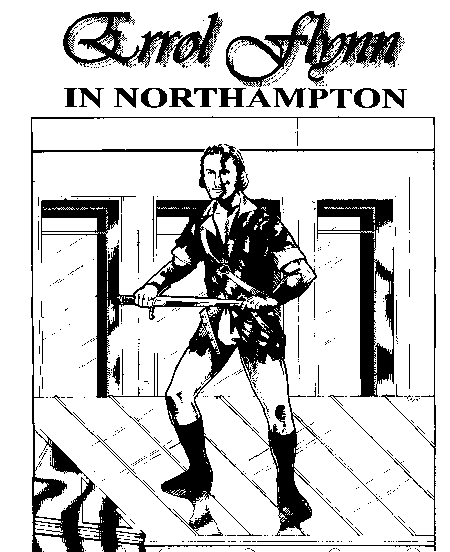
Flynn never let facts hinder
his life. When he was recruited by the Northampton Repertory Players at
the end of 1933, the local press announced that he was an Australian film
star, who had competed in the Olympic Games. Neither statement was true,
and it was obvious that he was a newcomer to acting. He lived well, due
to his ability to run-up large debts, and he wasn't too adverse to theft
and deception.
Connelly notes that it is easy to confuse the real-life Flynn with his reckless adventurer, on-screen image. Such an image is fostered by his autobiography, My Wicked. Wicked Ways, but Connelly does an immaculate job of sifting-out his half-true anecdotes for the more valuable grains of truth.
He explains that Flynn's bravado and fantasy- prone personality papered-over his shyness and his misfit status. Certainly he was a rebel against authority on and off-screen, and his wicked ways helped lead to his death in 1959, aged 50.
All Flynn's activities, and plays in Northampton, are reviewed and put into the context of his life before and after Northampton. A lot of painstaking research has gone into this volume, and you might expect it to be ditch-dull, despite the subject-matter, but Connelly marshals his findings in an accessible and lucid fashion. I can't wait to see his forthcoming book on Flynn's first wife, the film star, Lili Damita.
Sam
Peckinpah and the Rise of Ultraviolent Movies
Stephen Prince.
Athlone Press. 1998. Pbk.
282 pages.
Prince takes a thoughtful and academic look at how Sam Peckinpah constructed his movies, and how they have influenced contemporary productions. The main difference is that Peckinpah's project was to expose violence and to make people turn away from it in horror, today's filmmakers generally want you to enjoy the spectacle of graphic and stylistic screen violence.
This is a great in-depth study of Peckinpah's movie making skills and of their impact on cinema in general.
Superhero
A Biography of Christopher
Reeve
Chris Nickson.
Robert Hale. 1998. Hbk.
232 pages. £15.99.
As expected Nickson frames Reeve's story in terms of the horse riding accident in May 1995 that left him severely paralysed. The media has been full of stories about disabled people who dislike Reeve's attempts to escape his wheelchair, but this book shows us that he is a very determined person, and such behaviour has been typical throughout his life.
By the time he was 13, he was six foot two tall but he was no Superman. He had all sorts of childhood allergies, he suffered from asthma, he had alopecia, and he had Osgood-Schlatter disease which made his movements jerky. He was a physical mess, and his parents' divorce also had a heavy influence on his childhood. On the plus side, he was very bright, musically gifted, and good at certain sports. Almost by chance he started acting at school, and this allowed him to totally escape from the chains of reality. It didn't take long for him to want to be an actor.
Reeves' determination to
be successful at every- thing, at any price, is summed-up by reflections
on his teenage years when he skippered sailing boats, he said: "I would
win a lot. But it was at a certain cost. I would terrorize my crew. I was
really aggressive, demanding, and critical of myself and other people.
If I didn't win, it would set me back for days."
Here is a true man of steel.
Winona
Ryder The Biography
Nigel GoodaIl.
Blake Publishing. 1998.
Pbk. 240 pages. £9.99.
Ryder’s first big impact was playing the part of creepy Lydia Deetz in the quirky Beetlejuice (1988). This brought her derision from her classmates and a stalker; such are the trappings of fame.
As a child she was brought up in a Californian commune and her godfather was Timothy Leary. She feared being kidnapped to the extent that at 13 she wanted her parents to put bars on her bedroom window. From that came insomnia that has dogged her life. Her unconventional style of dress and offbeat ideas alienated her so much that she had only one school friend.
Goodall traces her career
path, which includes Heathers, Bram Stoker’s Dracula, Reality Bites, The
Crucible, Alien Resurrection to Celebrity. Her off-screen relationships
with the likes of Johnny Depp and her unconventional lifestyle and beliefs
are also explored. Goodall is an obvious fan of Ryder and he provides a
very readable account of her life.
RETURN TO BOOK REVIEW MENU